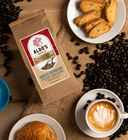
What Is a French Dark Roast? (Not What Most People Think)
Most people assume dark roast means bitter. Harsh. Burnt. That reputation exists because bad dark roast is everywhere — beans pushed too far, left sitting too long, served without any real craft behind them.
French dark roast done right is something else entirely.
What "French Roast" Actually Means

French roast is one of the darkest standard roast levels. The name refers to the roast profile — not the origin of the beans, not where the coffee was grown, not a style of brewing. It simply describes how far the beans were taken during roasting.
At this roast level, beans reach a deep, rich brown. They're developed to the second crack — the point where the cellular structure of the bean begins to break down, gases are released, and the internal oils are pulled to the surface. A distinct shift in flavor takes place.
Done correctly, French dark roast produces a cup that is bold, smooth, low in acidity, heavy-bodied, and built on bittersweet chocolate, toasted sugar, and roasted sweetness. It is intense. It is not burnt.
✦ Bold, full flavor from start to finish
✦ Smooth — no sharp edges, no harshness
✦ Low acidity — easy on the palate, easy on the stomach
✦ Heavy body that coats and lingers
✦ Bittersweet chocolate, toasted sugar, and roasted sweetness
The Roast Science (In Plain Terms)

When coffee beans reach French dark roast temperatures, a sequence of reactions happens. Maillard reactions create browning and flavor complexity. Caramelization develops sweetness and toasted notes. As moisture leaves the bean, it becomes more porous and soluble. And as the roast progresses, oil migration pulls the bean's natural lipids to the surface.
The longer a bean roasts, the less acidic it becomes — and the more its sweetness shifts toward toasted, caramel-like notes. The goal is pulling the roast at exactly the right moment. Go too far and you cross into ashy, flat territory. Stop at the right moment and you have something genuinely bold and smooth.
At Aldo's, we don't use lab equipment or color meters. Our roasting is guided by sensory skill built over years of experience, repetition, cupping, and consistency. We roast in small batches throughout the week — not in large runs that sit.
Why Dark Roast Gets a Bad Reputation
Most mass-produced dark roast coffee is over-roasted. Beans pushed past the second crack start to taste flat, ashy, and one-dimensional. The sweetness disappears. What's left is bitterness with nothing behind it.
That's not French dark roast. That's poor roasting.
A well-developed French dark roast is pulled at the beginning of the second crack — not past it. We've spent years perfecting the balance: reducing acidity, building sweetness, without crossing into bitter or burnt. The difference is everything.
Oil on the Beans: What It Is and Why It's There
If you've ever opened a bag of dark roast and noticed a shiny surface on the beans, you might have wondered if something was wrong. It's not.
Oil on the surface of dark roast beans is a perfectly normal and natural result of reaching the second crack during roasting. During this stage, the internal structure of the coffee bean changes — it expands in size, small fractures form throughout, and through those fractures, gases are released. Those gases bring the lipids naturally occurring inside the bean out to the surface.
These surface oils play a large role in the mouthfeel of a cup of coffee — coating the mouth and carrying aromatic compounds that enhance the body, depth, and richness of the cup.
This is not a sign of old coffee. It is not over-roasting. It is the natural behavior of a properly developed French dark roast. We wrote a full breakdown of this if you want to go deeper: Why Are My Coffee Beans Oily? A Roaster Explains →
What to Expect in the Cup

A proper French dark roast delivers bittersweet chocolate, toasted sugar, roasted sweetness, heavy body, and a smooth low-acid finish.
Some French dark roasts carry additional notes depending on origin. Our Ethiopia Washed Sidamo Guji carries notes of black tea, dark chocolate, and blackberry. Our Bali Blue Moon brings deep chocolate, vanilla sweetness, and a hint of almond. Our Orient Espresso blend — a combination of Ethiopian and Sumatran coffees — delivers rich brown sugar, chocolate, black tea, and a subtly floral jasmine finish.
Bold doesn't have to mean one-note.
How to Brew French Dark Roast Properly
Dark roast is more porous and soluble than lighter roasts, so it extracts faster. A few adjustments make a significant difference.
Water Temperature
Target 197°F–200°F. Never pour boiling water (212°F) directly onto the grounds — it scorches them and pulls harsh, ashy notes. Let your kettle sit about 30 seconds after boiling before you pour.
Grind Size
Use a slightly coarser grind than you would for medium roast. More surface area from a finer grind increases extraction — and dark roast doesn't need the help.
French Press
One of the best methods for dark roast. The longer steep and absence of a paper filter let the natural oils come through. Use a coarse grind, ~190°F water, 1:18 ratio, steep 4 minutes.
Pour Over or Drip
Both work well. Use slightly cooler water than you would for medium roast. A metal filter lets the natural oils through for added body; paper produces a cleaner cup. Personal preference.

Freshness at Aldo's
Aldo's is a Certified Organic, small-batch roaster based in Greenport, NY — roasting continuously throughout the week in intentionally small batches. Coffee is typically 2–7 days off roast when it reaches you.
Freshness at Aldo's comes from rotation, not shelf-life claims. Dark roasts degas and oxidize faster than lighter roasts, which is exactly why we don't roast large quantities in advance. The ideal window for whole bean dark roast is day 3 to day 21.
Store your beans in a cool, dry place in an airtight opaque container. Don't refrigerate or freeze. Grind only what you need immediately. The less exposure to air, heat, and light — the better.

Try Aldo's French Dark Roast
Dark roast has a reputation it doesn't deserve. Done right — small-batch, Certified Organic, pulled at exactly the right moment — it's one of the most complex and satisfying cups you can brew.
Shop Dark Roast Collection →