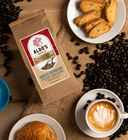
Why Biscotti and Coffee Belong Together
Watch the counter at our shop for ten minutes and you'll see it happen without anyone explaining it. Someone orders a coffee. Their eye drifts to the biscotti. And within a minute of sitting down, one end of that biscotto is in the cup.
Nobody teaches this. There's no sign. It's a pairing people arrive already knowing — coffee in one hand, a hard Italian cookie in the other — and almost nobody can say why it works.
It turns out there are real answers. Some are about baking. One is genuine physics, odd enough to have won a scientist a prize. And the history is stranger than the coffee-shop version — because the original partner for this cookie wasn't coffee at all.
We're in a decent position to walk you through it. We roast our coffee and make our biscotti under one roof in Greenport, and Aldo's has been here since 1987. The pairing isn't a marketing idea for us; it's what the counter looks like every morning. Here's why it works.
Built to Be Dunked: Why Biscotti Are Baked Twice
"Biscotti" comes from the Latin bis coctus — twice-cooked — and that's not a poetic name. It's the recipe. The dough is shaped into long logs and baked once. The logs are sliced. Then the slices go back into the oven and bake again, and that second bake is where a biscotto becomes a biscotto: it drives out the remaining moisture and sets the crumb into something dry, dense, and rigid.
Which means the thing people sometimes apologize for — "aren't they kind of… hard?" — is the entire point. Biscotti aren't a soft cookie that went stale. They're made not to be soft. Centuries before refrigeration, that dryness made them keep. Today, it makes them dunkable.
Here's the difference it creates. A soft cookie is already full of moisture, so hot coffee overwhelms it almost instantly — a few seconds and it's silt at the bottom of the mug. A biscotto is a dry, sturdy structure with room to receive the coffee. It softens where it meets the cup and holds together everywhere else. The texture that looks like a flaw is a design feature, and dunking is what the design is for.
(New to biscotti entirely? Our complete biscotti guide covers the styles, the flavors, and how they're made.)

Step one of the double bake: the dough is shaped into logs by hand before its first trip into the oven.
The Honest History: Wine First, Coffee Later
Now for the part most coffee-shop blogs get wrong.
Twice-baked bread is ancient — it predates coffee in Europe by a very long way. Roman bakers made twice-cooked rations because they traveled well and kept for ages; sailors carried them for the same reason. Whatever else is true about biscotti, they were not invented for coffee. When the technique was born, there was no coffee in Italy to dunk them in.
The almond biscotti most people picture — golden, oblong, sliced on the angle — is a Tuscan tradition from the town of Prato, where they're called cantucci. And here's the detail that surprises everyone: the traditional Tuscan way to eat cantucci isn't with coffee either. It's with Vin Santo, a sweet amber dessert wine, poured at the end of a meal with a few cantucci for dipping. Order that in Tuscany and you're doing it the old way. Dunk a biscotto in your espresso there and you've marked yourself as a modern.
So the coffee ritual — the one you and we and cafés everywhere practice — is far younger than the cookie.
We'd argue that takes nothing away from it. Traditions don't get grandfathered in; they earn their place, and coffee earned this one on merit. The same structure that survives a dip in dessert wine turns out to be even better suited to a hot cup — because heat is where the real magic of dunking happens. Which brings us to the physics.
The Physics of the Dunk (Yes, Real Physics)
A biscotto looks solid, but up close the crumb is porous — a network of tiny interconnected channels left behind when the second bake drove the moisture out. Touch one end to hot coffee and those channels start drinking. The coffee climbs up into the cookie the same way a spill climbs into a paper towel: capillary action.
This is not a loose metaphor. A physicist named Len Fisher took biscuit dunking seriously enough to apply a fluid-flow equation from 1921 — the Washburn equation — to predict how far liquid travels into a biscuit over time, and how long you can dunk before things go wrong. The work earned him an Ig Nobel Prize, the award for research that makes you laugh and then makes you think.
What happens inside the cookie is easy to picture. The hot liquid swells the starches and dissolves the sugar holding the crumb together. The dunked end turns warm and tender while the rest stays rigid enough to act as a handle. Overstay your welcome and the wet end can no longer support its own weight — the classic lost-biscuit tragedy, mourned at the bottom of mugs everywhere.
The good news: a biscotto's density buys you far more time than a soft cookie gets. And physics offers one genuinely useful technique — dunk at a shallow angle, so the coffee wets the underside while the top face stays dry. That dry top layer carries the load, and your biscotto survives dunks that would fell a lesser cookie. An actual engineering solution to a snack problem.

A few seconds at a shallow angle. (Seasonal bonus: that's our Pumpkin Spice Almond Biscotti.)
What Dunking Does to Flavor
Softer is only half of what you get. The better half is flavor.
Most of what we experience as flavor is actually aroma — as we covered in What Makes Coffee Taste the Way It Does?, the fruit and chocolate and toast in a cup are mostly smelled, not tasted. A dry biscotto keeps much of its aroma locked inside that rigid crumb. Hot coffee changes that: heat and moisture free the aromatic compounds, and they reach your nose with the steam coming off the softened bite. You're not imagining that a dunked biscotto seems more flavorful. The heat and moisture are helping release more of what was already there.
And one finding for the latte drinkers: Fisher's flavor research found milk-based drinks release even more flavor from a dunked biscuit than black tea or coffee — milk fat carries aroma compounds and lingers on the palate. If your ritual is a cappuccino and a biscotto, you're not cutting corners. You may be optimizing.
Why the Flavors Meet in the Middle
Texture and physics explain the dunk. They don't explain why the two taste right together. A few things are going on — and we'll be honest about which are solid and which are good stories.
The solid one: sweet against bitter. Coffee, especially a dark roast, carries a pleasant bitterness, and sweetness pushes back on how intensely you perceive it. A bite of biscotti genuinely makes the next sip taste smoother, and the coffee returns the favor by keeping the cookie's sweetness from cloying. Each makes the other taste more like its best self — the same logic as coffee with dark chocolate.
The kinship: browning. The flavors in roasted coffee — toasted nut, caramel, cocoa — come from the browning reactions that happen in the roaster. The flavors in a biscotto's crust and its toasted almonds come from the same family of reactions happening in the oven. Coffee and biscotti taste related because, chemically speaking, they grew up in the same neighborhood: sugars and proteins transformed by heat.
The caveat we owe you: you'll sometimes read that foods sharing flavor compounds are scientifically proven to pair well. Treat that as an interesting idea, not settled science — researchers have tested it, and it doesn't hold up as a universal law. What reliably makes a pairing work is balance: matched intensity, contrast where you want it. Which, happily, is something you can judge with your own mouth.
On intensity, one practical rule: match the weight. A heavy-bodied dark roast can stand up to a dense, chocolate-dipped biscotto; a delicate cup can get steamrolled by one. Pair strong with strong and gentle with gentle, and you'll rarely go wrong.
Two Crafts, One Roof
Here's where we stop being neutral.
We roast our coffee and make our biscotti under one roof in Greenport. The coffee is roasted in small batches throughout the week, and the biscotti are made by hand on the same floor — dough shaped into logs, baked, sliced, and baked again. Aldo's has been part of this town since 1987, and coffee-and-biscotti isn't a merchandising angle for us — it's the shop.
It also means we've had a long time to figure out which of ours belong together. A few pairings straight from our counter:
- The house classic. Our dark roasts — bittersweet chocolate, toasted sugar, heavy body — with the original Almond Biscotti. The toasted almond against that bittersweet depth is the pairing our counter was built on.
- Bold and bolder. The same dark roasts alongside the Belgian-chocolate-dipped almond or hazelnut biscotti. Matched intensity; nothing gets drowned.
- The espresso classic. Orient Espresso — rich brown sugar, chocolate, black tea, and a subtly floral jasmine finish — with hazelnut biscotti. The roast's brown-sugar depth and the toasted hazelnut are the browning kinship, in a cup.
- While it lasts. Pumpkin Spice Almond Biscotti, our seasonal — the almond classic baked with pumpkin purée and a warm spice blend. It sits naturally next to our medium roasts, where the Guatemala's toffee and the Costa Rica's honey and caramel meet the spice halfway.
Want our full matchup, roast by roast? Grab the free Coffee + Biscotti Pairing Guide. But these are starting points, not rules. The whole point of a ritual is that it becomes yours.
How to Do the Ritual Right
There's no wrong way to eat a biscotto, but if you want the physics on your side: start with a hot, full cup — heat is what releases the aroma. Hold the biscotto at a shallow angle and dunk one end for a few seconds; two or three is plenty, because a biscotto is sturdy, not invincible. Keep the top side dry so it can do the structural work. Eat the softened end while it's warm. Repeat until the cookie is gone, which will be sooner than you planned.
And if you'd rather not dunk at all? Also correct. The crunch of a dry biscotto against a sip of hot coffee is its own version of the contrast — texture instead of temperature. In Tuscany, they'd hand you a glass of Vin Santo and tell you we're all doing it wrong. Traditions are like that.
The reason this pairing survives — why it jumped from wine to coffee, crossed an ocean, and shows up on our counter every morning without anyone teaching it — is that everything about it actually works. The cookie is built for the cup. The physics cooperates. The flavors meet in the middle. And in at least one shop in Greenport, both halves of the ritual are made under the same roof.
Run the Pairing Yourself
The Biscotti Sampler brings home all five of our handmade flavors — from the original almond to the Belgian chocolate–dipped — so you can find the one that belongs next to your cup.
Related Reading
- What Is Biscotti? A Complete Guide to the Traditional Italian Cookie
- What Makes Coffee Taste the Way It Does?
- What Is a French Dark Roast? (Not What Most People Think)
- The Best Biscotti to Buy Online
- Biscotti Gift Ideas: How to Choose the Perfect Gift
Frequently Asked Questions
Is it okay to dunk biscotti in coffee, or is that not authentic?
Dunk away. The traditional Tuscan pairing for almond biscotti (cantucci) is actually Vin Santo dessert wine — the coffee dunk is a modern café ritual. It isn't ancient, but it works beautifully, which is why it stuck.
Why do biscotti hold up in coffee better than regular cookies?
Soft cookies are already full of moisture and fat, so hot coffee dissolves them in seconds. A twice-baked biscotto is dry, dense, and porous — it drinks in the coffee through capillary action and softens at the surface while the rest stays rigid.
How long should you dunk a biscotto?
A few seconds — two or three is usually plenty. Hold it at a shallow angle so only the bottom gets wet and the dry top keeps the cookie structurally sound. Biscotti's density lets them survive longer dunks than soft cookies, but no cookie is invincible.
What do Italians traditionally dip biscotti in?
In Tuscany, where the classic almond biscotti comes from, the traditional dip is Vin Santo — a sweet dessert wine served after the meal. Dipping biscotti in coffee is a newer convention popularized in cafés outside Tuscany.
How do you match a coffee to a biscotti flavor?
Match intensity. Heavy-bodied dark roasts stand up to dense and chocolate-dipped biscotti; brighter medium roasts sit well with spiced or more delicate flavors. Pair strong with strong, gentle with gentle, and let contrast — sweet cookie, pleasantly bitter coffee — do the rest.
Why does dunking make biscotti taste better?
Hot coffee softens the crumb, and the heat and moisture help release aromatic compounds locked inside the dry cookie — so a dunked bite delivers more of the flavor that was already there.
Is "biscotti" singular or plural?
Plural — one cookie is a biscotto. In American English "biscotti" gets used for both, and everyone will know what you mean.
Do you have to dunk biscotti at all?
No. Plenty of people prefer the clean crunch of a dry biscotto between sips — the contrast of crisp cookie and hot coffee is its own pleasure.