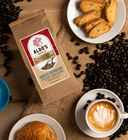
What is Biscotti? A Complete Guide to the Traditional Italian Cookie
We've been baking biscotti in Greenport since 1987, and the part most people skip over is the part that matters most: the second bake. We mix the dough, shape it into long logs, bake them once, then slice them while they're still warm and send them back into a cooler oven to dry out. That second pass is what turns a soft loaf into a cookie crisp enough to survive a dunk in hot coffee.
Almost everything people find confusing about biscotti — why it's hard, why it lasts so long, why it's practically built for dipping — comes back to that one step.
Biscotti means "twice-baked." The word comes from the Latin biscoctus, meaning twice cooked. A biscotto is a crisp, dry Italian cookie that is baked once as a loaf, sliced, and then baked again to remove moisture and create its signature crunch. That second bake is why biscotti keeps far longer than most cookies, and why it holds its shape when you dip it in coffee instead of falling apart in the cup.
Want the short version you can keep? Get our free Coffee + Biscotti Pairing Guide →
Already know you want some? Aldo's biscotti is twice-baked by hand in Greenport, NY — made with premium nuts, real chocolate, and no seed oils or preservatives.
Shop the biscotti collectionWhat Does Biscotti Mean?
Biscotti comes from the Latin biscoctus — bis ("twice") and coctus ("cooked"). Twice-cooked. The word describes the method, not a flavor or a shape, which is why it has stuck around for centuries while the recipes around it kept changing.
There's a small language quirk worth knowing. In everyday Italian, biscotti is simply the plural word for cookies or biscuits in general (one is a biscotto). The specific crunchy, twice-baked almond cookie that most people outside Italy picture when they hear "biscotti" is traditionally called cantucci in Italy. More on that difference further down.

What Is Biscotti?
Biscotti is a dry, crunchy, oblong Italian cookie made to be eaten slowly — usually alongside a drink rather than on its own. The classic versions are built from a short list of ingredients: flour, sugar, eggs, and nuts. Many traditional recipes use little or no butter and no oil at all, which is part of why they turn out so firm and keep so well.
That lean, dry structure is the whole personality of the cookie. A soft, buttery cookie crumbles the second it hits liquid. Biscotti holds together, drinks in the coffee, and softens just enough to bite. It's less a sweet indulgence and more a sturdy, satisfying companion to a cup.
The biscotti we bake at Aldo's follows that traditional logic — clean ingredients, premium nuts, real chocolate, no seed oils, and no preservatives. The crunch comes from the bake, not from additives.
Where Biscotti Comes From
The idea behind biscotti is old — older than the cookie jar on your counter by a couple thousand years. The Romans baked twice-cooked breads and cakes specifically because driving out the moisture made them last. Dry food didn't spoil. That made it ideal for soldiers, sailors, and anyone traveling long distances without a way to keep food fresh.
The version most people recognize today took shape much later in Tuscany, in the city of Prato. There, bakers leaned into almonds and a very hard, very dry texture, producing the cookie now known as cantucci. In 1858, a Prato baker named Antonio Mattei made the style famous with his almond cantucci, traditionally served with a glass of Vin Santo dessert wine to soften them. That pairing — hard cookie, sweet wine — is still the classic Tuscan way to eat them.
From there the cookie spread and adapted. Bakers in different regions and countries added chocolate, citrus, spices, dried fruit, and softer doughs. The twice-baked method stayed constant. The flavors became almost limitless.
Why Biscotti Is Twice-Baked
The second bake isn't tradition for tradition's sake. It's doing real work.
In the first bake, the dough cooks through and sets into a firm loaf, but a fair amount of moisture is still trapped inside. That's intentional — a slightly soft loaf is exactly what you want, because it's still possible to slice cleanly without shattering.
Honestly, the first bake is the easy part. The trickiest moment is timing the slice. Cut the logs while they're too hot and they crumble and tear; let them cool too long and the knife drags and the edges crack instead of cutting clean. There's a narrow window — still warm, just set — where a serrated knife glides straight through and leaves those clean diagonal faces. We cut on the diagonal, then lay the slices cut-side down for the second bake.
The second bake runs at a lower temperature. Here's what's actually happening: heat gives the remaining water molecules enough energy to escape the dough as vapor. The lower temperature is slow and steady, so the cookies keep drying out without scorching. By the time they come out, most of the internal moisture is gone.
That low moisture content is the payoff. It's what makes biscotti crisp all the way through, what gives it a long shelf life, and what makes it resistant to going stale or moldy. Less water in the cookie means fewer ways for it to spoil. The crunch and the keeping power are the same trait, viewed from two angles.

Biscotti vs Cantucci: What's the Difference?
This trips up a lot of people, so here's the clean version: cantucci are a specific type of biscotti. All cantucci are biscotti; not all biscotti are cantucci.
"Biscotti" is the broad category — any twice-baked cookie in the family. "Cantucci" refers to the traditional Tuscan almond version from Prato. The practical differences:
- Ingredients: Cantucci are made with whole almonds and traditionally contain no butter or oil. Biscotti more broadly can include butter, different nuts, chocolate, citrus, or dried fruit.
- Texture: Cantucci are notably hard and dry — built to be dipped. Other biscotti can run a touch softer or richer depending on the recipe.
- How they're served: Cantucci are classically dunked in Vin Santo. Biscotti in general pair with coffee, tea, milk, or wine.
- Region and name: Cantucci is the Tuscan name and style; "biscotti" is the term that traveled and became the catch-all word abroad.
If you order "biscotti" in the United States, you'll almost always get something in the cantucci tradition — even if the menu doesn't use that word.
Popular Biscotti Flavors
The classic is, and probably always will be, almond biscotti — toasted almonds, balanced sweetness, nothing hiding the nut. It's the flavor cantucci was built on, and in our Greenport bakery it's still the one we bake most often. We toast the almonds before they go into the dough, which sounds like a small thing but isn't: it deepens the flavor so you taste roasted almond all the way through the cookie, not just on top. If you've never really had biscotti and want to know what it's supposed to taste like, start here.
If almond is the purist's pick, chocolate hazelnut is the one that wins people over. Toasted hazelnut and real chocolate — the same pairing that made gianduja famous in Turin — in a cookie sturdy enough to take a dunk. The chocolate softens just slightly against hot coffee without turning to mush. It's the one we hand people who say they don't love biscotti; more often than not, they just hadn't had this version yet.

From there it opens up. A few of the other directions worth knowing:
- Chocolate almond — almond biscotti with cocoa worked into the dough and chocolate on top, for people who want the crunch with more depth.
- Hazelnut — nuttier and a little softer in character than almond, great with a darker roast.
- Almond lavender — almond with a light floral note; less common, and a nice change of pace.
- Anise — the old-world Italian flavor, with a gentle licorice warmth.
- Citrus and spice — orange or lemon zest for brightness; cinnamon and ginger for a cookie that leans toward the holidays.
The nice thing about a twice-baked cookie is how well it carries flavor. Because there's no heavy butter or oil competing, the nuts and chocolate come through clearly.

Why Biscotti and Coffee Belong Together
Biscotti and coffee aren't paired by accident. The cookie was, in a real sense, engineered for the cup.
Because biscotti is dry and low in fat, it soaks up coffee instead of dissolving or going greasy in it. Dip it for a second or two and the surface softens into something between a cookie and a cake, while the center stays firm. A buttery cookie can't do that — it just falls to pieces. The biscotti's whole structure is what makes the dunk work.
The flavors line up, too. Toasted almonds and hazelnuts sit naturally next to the bittersweet, caramelized notes of a dark roast. The cookie's restrained sweetness keeps the coffee from tasting sharp, and the coffee keeps the cookie from tasting flat. Each one fills in what the other is missing.
We happen to do both under one roof — roast the coffee and bake the biscotti — so we've spent a lot of mornings testing exactly this combination.
Biscotti makes more sense next to coffee. Pair a box with one of our small-batch roasts — it's the combination the cookie was built around.
Shop small-batch coffeeGet our Coffee + Biscotti Pairing Guide
Which roast goes with which cookie, and how long to dip. Free, straight to your inbox.
Send me the guideIs Biscotti Healthy?
Biscotti is often described as a "lighter" cookie, and there's some truth to it — but it's worth being honest about why.
Traditional biscotti uses little or no butter and no oil, so it tends to carry less fat than a typical rich, soft cookie. The nuts add protein and some healthy fats, and the flour contributes fiber. None of that makes biscotti a health food, though. It still has sugar, and because it's dense and dry, the calories are concentrated — a couple of pieces add up faster than they feel like they should.
The honest answer: biscotti can be a reasonable choice as part of a balanced day, especially when it's made with clean ingredients rather than seed oils and preservatives. Eaten mindfully, alongside a coffee, it's a satisfying bite that doesn't pretend to be anything it isn't.
How Long Does Biscotti Last?
This is where the twice-baked method really pays off. Stored in an airtight container at room temperature, biscotti stays fresh and crunchy for about two to three weeks — and often longer, since there's so little moisture left in the cookie for it to go stale or spoil. For longer storage, biscotti freezes well for up to about three months; just let it come back to room temperature before serving.
A few practical notes. Keep biscotti away from humidity, which is its main enemy — moisture in the air is what eventually softens that crunch. If a piece does soften, a few minutes in a low oven crisps it right back up. And because our biscotti is made fresh without preservatives, an airtight container is doing the preserving the old-fashioned way: by keeping the air out.
Biscotti Without Gluten
Biscotti doesn't have to be made with wheat. Swap the wheat flour for almond flour and the same twice-baked method still produces a crisp, dunkable cookie — if anything, an almond-flour version leans even harder into the nutty character that makes biscotti good in the first place.
We bake two biscotti without gluten — an almond and a chocolate almond — made the same handmade way, just without the wheat. One honest note: we're not a dedicated gluten-free facility. We bake these in the same kitchen as our wheat biscotti, so while they're made without gluten, we can't call them certified gluten-free or promise they're safe for celiac disease or a serious wheat allergy. If that's you, reach out before you order and we'll give you a straight answer.
Where To Buy Authentic Biscotti
"Authentic" gets thrown around a lot, so here's what it actually means with biscotti: twice-baked the traditional way, made with real ingredients, and crisp because of the method rather than because something was added to it.
That's the line we hold at Aldo's. We've been baking biscotti by hand in Greenport, New York since 1987 — small batches, premium nuts, real chocolate, no seed oils, no preservatives. We ship it fresh rather than letting it sit in a warehouse, which matters more than people expect for a cookie whose entire appeal is texture.

Sending a gift? Coffee and biscotti is one of those combinations that feels generous without trying too hard.
Shop the best-sellers gift basketWant the snack version? Broken biscotti is the same handmade biscotti in imperfect pieces — perfect for dunking, snacking, or keeping a stash near the coffee maker.
Try broken biscottiFrequently Asked Questions
What does biscotti mean?
Biscotti means "twice-baked," from the Latin biscoctus (bis, twice, and coctus, cooked). It describes the baking method: the cookie is baked once as a loaf, sliced, then baked again to dry it out.
What is biscotti?
Biscotti is a dry, crunchy, oblong Italian cookie made from flour, sugar, eggs, and nuts, baked twice so it turns crisp and keeps for weeks. It's designed to be dipped in coffee, tea, milk, or wine.
Is biscotti a cookie?
Yes. Biscotti is a type of Italian cookie. It's just made by a different method than most — baked twice instead of once — which is why it's harder and drier than a typical cookie.
Why is biscotti so hard?
The second bake removes most of the moisture from the cookie. Less water means a firmer, crunchier texture. That hardness is intentional — it's what lets biscotti hold up when you dip it instead of crumbling apart.
Do you dip biscotti in coffee?
Yes, and it's the most popular way to eat it. Because biscotti is dry and low in fat, it soaks up coffee and softens slightly without disintegrating. Italians also traditionally dip the almond version (cantucci) in Vin Santo dessert wine.
What is the difference between biscotti and cantucci?
Cantucci are a specific type of biscotti — the traditional Tuscan almond version from Prato, made with whole almonds and no butter or oil. "Biscotti" is the broader category that can include chocolate, hazelnut, citrus, and other variations. All cantucci are biscotti, but not all biscotti are cantucci.
How long does biscotti last?
Stored airtight at room temperature, biscotti stays fresh for about two to three weeks, and often longer because of its low moisture content. It also freezes well for up to about three months.
Is biscotti healthier than regular cookies?
Often it's lower in fat, since traditional biscotti uses little or no butter and no oil. But it still contains sugar and is calorie-dense because it's so dense and dry, so portion size matters. It's best thought of as a reasonable treat, not a health food.
Can biscotti be made without gluten?
Yes. Using almond flour in place of wheat flour produces a crisp, dunkable cookie with the same twice-baked method. Aldo's bakes an almond and a chocolate almond biscotti without gluten — though we're not a dedicated gluten-free facility, so we don't recommend them for celiac disease or a serious wheat allergy.
Where can I buy authentic biscotti online?
Look for biscotti that's twice-baked the traditional way, made with real ingredients, and shipped fresh. Aldo's bakes biscotti by hand in Greenport, NY and ships it nationwide — small batches, no seed oils, no preservatives.
What coffee goes best with biscotti?
A bold, smooth dark roast is the natural match — it's what we roast, and it's what the cookie was built for. The bittersweet chocolate and toasted-sugar notes of a dark roast line up with the toasted nuts, and its heavier body stands up to the dunk. Almond biscotti with one of our dark roasts is a reliable place to start.
Now You Know What Biscotti Is — Try the Version We Actually Bake
You've got the whole picture: twice-baked for crunch, built to last, made for coffee, and rooted in a centuries-old Italian method. The only thing left is to taste a proper one.
Browse the full biscotti collection, start with the biscotti sampler if you want to taste the range, or pair a box with one of our small-batch roasts. Sending it to someone? The best-sellers gift basket handles that. Either way, you're getting biscotti baked by hand in Greenport, the way it's been done since 1987.
Twice-baked by hand. Shipped fresh.
Shop Aldo's biscotti