The Best Coffee for French Press (And Why Yours Might Taste Off)
People walk into the café in Greenport every week and ask me some version of the same question. "I bought a French press, made coffee at home, it came out muddy and bitter. What am I doing wrong?"
Usually they're not doing anything wrong. The press is fine. The water's fine. The grind, mostly fine.
The coffee was wrong.
Here's the thing nobody tells you about French press: it's the most honest brewer ever made. No paper filter to hide behind, no pressure to push past flaws, no fancy machine doing the work. Four minutes, hot water, a screen. Whatever's in the bag ends up in your cup — the good and the bad.
So if your French press tastes off, the press isn't lying to you. The coffee is.
We've been roasting in small batches in Greenport since 1987, and this is the guide I wish I could hand every one of those customers. Every coffee we recommend below is one we roast, brew, and serve ourselves in the café. Why French press is so unforgiving, what to look for in a bag, what to skip, and how we'd brew it. Plus the small thing that makes the whole ritual better — pairing it with the right biscotti. We bake those in the same building.
And if you want a shortcut — skip to the bottom and try our Coffee Doctor. Answer a few questions, get a diagnosis.
What's the Best Coffee for French Press?
The best coffee for French press is a fresh, medium-dark to dark roast, ground coarse — about the texture of coarse sea salt — and brewed within a few weeks of its roast date. Thick-bodied, low-acid Indonesian coffees like Sumatra and Bali are the classic match, but any freshly roasted dark roast with real body will do the method justice.
Freshness matters more here than brand or price. French press has no paper filter to hide behind, so a stale bean tastes flat and papery in a way a drip machine would quietly cover up. Buy coffee with an actual roast date printed on the bag, grind it right before you brew, and you're most of the way to a good cup.
Our specific picks are right below — then the rest of this guide explains the why.
Quick Picks: The Best Coffee for French Press
In a hurry? Here's where I'd point you, based on the kind of cup you're after. The rest of this guide explains the why.
| If you want… | We recommend |
|---|---|
| Best overall | Earthy & Seductive |
| Smoothest cup | Bali Blue Krishna |
| Boldest cup | Orient Espresso |
| Decaf | Decaf (Water Process) |
What Makes a Great French Press Coffee?
French press is immersion brewing. The grounds and the water sit together for four full minutes, with nothing but a metal screen between the coffee and your cup. There's no paper filter pulling out the oils and the fines — which is exactly why French press body comes through so heavy and velvety, and exactly why the method shows every flaw in whatever you put in it.
So a great French press cup really comes down to three variables, in this order:
- Roast level — medium-dark to dark roasts hold up best to the long steep.
- Grind — coarse, like coarse sea salt, every single time.
- Freshness — fresh coffee is easier to brew well than expensive coffee. The age of the bean matters more than the price on the bag.
Get those three right and the rest is preference. The sections below break each one down — then I'll give you the exact bags and the recipe I'd actually start with.
The Roaster's Rule
Coarse grind + medium/dark roast + fresh beans = the cleanest French press starting point.
Why French Press Is Unforgiving
Most coffee makers protect you from your beans. A drip machine pulls hot water through a paper filter that traps oils and fines. Pour over does the same thing — paper strips out the heavy stuff, you get a clean cup. Espresso runs so fast (25 seconds) that there isn't time for slow-developing off-flavors to fully come through.
French press does none of that.
You drop coarse grounds into the chamber, pour 190°F water on top, and let it sit for four minutes. No filter standing between you and the bean. When you press, a metal mesh holds the grounds back, but the oils, the lipids, the dissolved solids — all of that comes through. That's what gives French press its signature mouthfeel. Heavy. Velvety. Coats your tongue.
Here's the part that matters: those same oils and solids are exactly what go bad first when coffee gets stale.
Coffee is a perishable product. From the day it's roasted, coffee slowly changes as it releases CO₂ and is exposed to oxygen. The lipids on the surface of the bean — the things that give a French press cup its body — break down on contact with oxygen. In a drip machine, you'd never know. The paper filter strips most of it out before it hits your cup. In a French press, you taste every bit of it.
A stale bag of coffee makes a flat, papery French press cup. The same bag in a Mr. Coffee tastes about 70% as good as it should — fine, you wouldn't know better. The press tells you the truth.
That's why the bean matters more here than anywhere else. And it's why the answer to "what's the best coffee for French press" almost never starts with a brand. It starts with a roast date.
What to Look For in a Bag
A few things, in this order.
A roast date on the bag. Not a "best by" date. A roast date — the day the coffee was actually roasted. If a bag has a "best by" stamp two years out and no roast date, the company is hiding when it was roasted because it doesn't want you to know. That's a problem. We print the roast date on every bag we ship. Most specialty roasters do. Many grocery-store coffees don't.
Coffee that's between three days and three weeks off roast. Day-of is too fresh — coffee needs to degas, especially dark roasts, or your press will fight you and the cup will taste raw. After day 21 or so, the curve starts heading the wrong way. The sweet spot is somewhere in the middle. We sell ours one to three days off roast and you brew it from there.
A roast level that holds up to four minutes of contact. French press steeps for a long time, which means the coffee has time to develop. Light roasts can come through thin and grassy in that window — they were built for shorter, hotter percolation brews. Dark and medium-dark roasts shine. The longer extraction pulls out chocolate, caramel, and nutty notes without going sour. The body fills in.
A coffee with body to begin with. Some coffees are naturally light-bodied and bright. Others are heavier, with a thicker mouthfeel. French press amplifies whatever's already in the bean. If you start heavy, you finish heavier. If you start thin, the press won't add weight that wasn't there.
Whole bean, not pre-ground. Pre-ground coffee ages much faster than whole bean — once you break the cell wall, oxygen reaches everything at once. If you don't have a grinder yet, get a burr grinder before you spend money on fancier beans. The grinder matters more than the next $5 of coffee. We covered grinder choices and what each grind size does in our grind size guide, if you want to go deeper.
If you're curious why some bags look shinier than others — that's not a defect, that's chemistry. We wrote about why coffee beans get oily too.
What Roast Works Best in a French Press?
If roast level is the biggest lever you've got, here's how the three levels actually behave once they hit a four-minute steep.
Light roast. It can work, but it asks for more care. Light roasts were built for shorter, hotter brews, so in a long immersion they often read thin and a little grassy, and the delicate florals get muted. If you love a brighter cup, you can do it — grind a touch finer, keep your water hotter — just go in knowing it's the harder road.
Medium roast. Balanced and reliable. You get sweetness, chocolate, and enough body to carry the method without much fuss. Our medium roasts (Guatemala, Costa Rica) sit right here — a dependable middle if dark feels like too much.
Dark roast. This is the heart of the method. Dark roasts give you body, lower acidity, and a heavier mouthfeel, and the long extraction pulls chocolate and caramel forward without tipping into sour. Most of our lineup is French dark — bold, smooth, low-acid — which is exactly what French press was built around.
One important distinction: a French dark roast is not the same thing as "coffee for French press." "French roast" describes how dark the beans are pulled; "coffee for French press" just means fresh, coarse-ground, medium-dark-to-dark coffee. A French roast happens to brew beautifully in a press, but you don't need that exact roast level to get a great cup. If the naming trips you up, here's what a French dark roast actually means. And the slight sheen you'll see on darker beans is normal — why dark roast beans look oily — and in a press, those surface oils stay in the cup instead of getting stripped by paper.
| Roast | Body | Acidity | French press fit | Aldo's match |
|---|---|---|---|---|
| Light | Light, can read thin | Higher, brighter | Workable with care | Better in a pour over |
| Medium | Medium to full | Balanced | Reliable | Guatemala, Costa Rica |
| Dark | Full, heavy, velvety | Low | Ideal | Earthy & Seductive, Sumatra, Bali Blue, Orient Espresso |
Which Origins Work Best?
Roast level sets the body; origin sets the flavor. A few patterns hold up reliably in a French press.
Indonesian (Sumatra, Bali). The classic French press origin. Wet-hulled processing — Giling Basah, the traditional Indonesian method — gives these beans a thick, syrupy body and an earthy, low-acid depth that the long steep amplifies beautifully. Our Bali Blue Krishna is the easy example here — deep chocolate, vanilla, molasses, heavy body. If you want a coffee that's practically built for immersion, start in Indonesia.
South & Central American (Brazil, Colombia, Guatemala). The dependable, crowd-pleasing lane. You get chocolate, nuts, and balance — coffees that brew clean and rich without any fuss. A safe bet when you're brewing for a table of people with different tastes.
East African (Ethiopia, Kenya). Bright, floral, fruit-forward, and more delicate. These coffees are stunning, but the long immersion brew highlights body more than delicate floral notes, so they're a better fit if you specifically like a lighter, brighter cup — and they reward a slightly shorter steep. Not wrong for the method, just more delicate. If a bright morning cup is what you're after, this is your lane.
What Grind Size Should You Use?
Coarse. Picture coarse sea salt or rough breadcrumbs — that's the target, and it's the single most common thing people get wrong.
- Too fine and the cup turns bitter and muddy. The grounds over-extract through the four-minute steep, and the fines slip straight through the mesh into your cup.
- Too coarse and it comes out weak and thin. The water can't pull enough out in the time it has.
If you're ordering pre-ground from us, choose the French Press / Percolator (coarse) option and you're set. If you're grinding at home, a burr grinder gives you the even, consistent coarse grind a French press needs — and for the full breakdown of grind sizes across every brew method, here's our complete grind size guide.
Why Freshness Matters Even More in a French Press
Every other brewer hides a stale bean a little. French press hides nothing. With no paper filter standing between the grounds and your cup, the brew is direct and full-bodied — which means freshly roasted coffee isn't a nice-to-have here, it's the difference between a velvet cup and a papery one.
That's the whole reason we roast in small batches through the week instead of in big runs, and ship one to three days off roast — so the coffee lands while it's still inside its window, not after months on a shelf.
Fresh beans matter more than brand. A modest, freshly roasted bag beats an expensive one that's been sitting on a shelf for six months — and in a French press, you'll taste the difference on the first sip.
Five Things to Skip
A few specific picks that almost always end badly in a French press. Worth naming so you don't waste a bag.
Anything labeled "Italian Roast" or generic "French Roast" from a grocery shelf. Here's a confusing one. "French roast" describes a roast level — beans pulled at the start of second crack, dark and bold. Done well, it's exactly what French press wants. Done poorly, it's how mass-market roasters mask defective green coffee with char. The bag in your hand isn't necessarily one or the other — but if it's been sitting on a shelf for six months and there's no roast date, assume it's the second one. Our French dark roasts are pulled at the beginning of second crack, intentionally, with quality green coffee underneath. There's a difference. (We covered this in detail in What Is a French Dark Roast?)
Pre-ground drip coffee. Wrong grind size, and likely stale. Drip grind is too fine for French press — it'll over-extract through the four minutes and pass right through the mesh. You end up with bitter sediment in the cup.
Flavored coffees with added oils. The added flavoring oils turn slick and weird in the long steep. Skip the hazelnut, the vanilla, the pumpkin spice. If you want flavor, add it after.
Washed light roasts from Ethiopia or Kenya. These are beautiful coffees in a pour over. Bright, floral, fruit-forward. In a French press, the long steep mutes everything that makes them special and the body comes out thin. Wrong tool for the job.
Anything you can't find a roast date on. This is the simplest filter. If the bag won't tell you when it was roasted, the company isn't proud of how long it's been sitting. Move on.
This isn't about putting down other roasters or other coffees — every coffee has a brewer it shines in. It's about matching the bean to the method. French press has specific needs, and these specific picks fight against them.
A Few Questions People Ask Before They Buy
Three questions come up more than any others when people start paying real attention to what's in the bag. Here are the honest answers — the kind we'd give you across the counter.
Does French press coffee actually taste better?
Better is the wrong word. Different is the right one.
French press uses full immersion — grounds and water sit together for four minutes. No filter paper. That changes two things you can taste immediately. The natural oils in the bean stay in the cup, which gives French press its signature heavier mouthfeel and richer body. And because nothing's being absorbed by paper, the flavors land fuller — chocolate notes read deeper, fruit notes read brighter, earthy notes read more grounded.
If you like a clean, light cup that highlights single-origin nuance, a pour over usually wins. If you like a cup with weight to it — something that feels like it was made for you, not strained for you — French press wins.
The catch: French press doesn't forgive bad inputs. Stale beans, too-hot water, the wrong grind — paper filters can mask those mistakes. French press shows them. Get the inputs right and yes, it tastes noticeably better than the same coffee through a drip machine. Get them wrong and it tastes worse. That's the trade.
What does French roast coffee taste like?
Quick clarification first, because the language gets confusing. French roast and French press are two different things. French press is a brewing method. French roast is a roast level — one of the darkest.
French roast coffee tastes like bittersweet chocolate and toasted sugar. There's a roasted sweetness underneath, low acidity, and a smooth finish. The beans go past second crack, which is where the surface oils develop and the sugars caramelize. Done well, the cup is bold without being harsh.
Done poorly, French roast tastes burnt. That's the line every dark-roast roaster walks. We pull our dark roasts at the beginning of second crack — bold and smooth, not scorched. The difference is craft, and you taste it on the first sip.
French roast in a French press is one of the better pairings in coffee. The body of the brewing method meets the depth of the roast, and the cup carries.
How do you choose a dark roast for French press?
Four things matter, in order:
- Whole bean, not pre-ground. Pre-ground coffee loses flavor within days. If you're going to the trouble of brewing French press, grind fresh.
- Recent roast date on the bag. For French press, coffee shines during the first several weeks after roasting — which is why we print a roast date on every bag. Anything labeled with a "best by" date two years out has been sitting in a warehouse. Look for an actual roast date.
- Surface oils that look right. A good dark roast has a slight sheen — that's the natural oils that migrated to the surface during second crack. Not soaked, not dry. A little shine.
- Flavor notes you can read in plain English. If the bag says "chocolate, low acid, smooth" — you know what you're getting. If it says nothing, the roaster isn't paying attention.
Once you've got those four, the rest is preference. Below is where I'd actually start, depending on the version of bold you're after.
What Actually Works (Our Picks)
Everything we roast is 100% Arabica, USDA Organic, small-batch roasted throughout the week in Greenport. Most of our lineup is French dark roast — bold, smooth, low-acid, never burnt. That profile is exactly what French press was made for.
Here's where I'd start, depending on what you like.

Earthy & Seductive (French Dark) — If I had to pick one coffee for one French press, this is it. It's a blend of two naturally-processed beans (Honduras Natural and Ethiopia Natural), which means the fruit comes through differently than a typical dark roast. Malted chocolate, pear, and honey with a bright citrus finish. Four minutes in the press and it comes out velvet-textured. If someone walked into the café and asked me for one French press coffee, this is the bag I'd hand them.
Try Earthy & Seductive in your French press →
Sumatra Single Origin (French Dark) — Sumatra is the classic French press coffee for a reason. Wet-hulled processing gives the bean a thick, syrupy body that the press absolutely amplifies. Earthy and full-bodied, with semi-sweet chocolate, cedar, caramelized vanilla, and warm spices. If you've had Sumatra somewhere and loved it, this is the one.

Bali Blue Krishna (French Dark) — Another wet-hulled Indonesian, a little more polished than the Sumatra. Deep chocolate, vanilla sweetness, molasses, a hint of almond on the finish. Bold but smooth. A good pick if you want depth without going as heavy as the Sumatra.
Shop Bali Blue Krishna →
Orient Espresso (French Dark) — This is our espresso blend, but it's a sleeper pick for French press, and the boldest cup on this list. Built around Ethiopia (washed and natural) plus Sumatra. Rich brown sugar, chocolate, black tea, a subtly floral jasmine finish. Slightly more layered than a single origin. Worth trying if you want maximum intensity in the cup.
For the boldest cup — shop Orient Espresso →
Decaf Blend (French Dark, Water Process) — Worth mentioning because most decaf is hollow in a French press — old, flat, no body. Ours is decaffeinated with a chemical-free water process, dark roasted fresh, and it actually holds up. Rich cocoa, toasted toffee nut, smooth. If you're a nighttime French press drinker, this is the move.
If you can't decide, the Coffee Discovery Box gives you eight quarter-pound bags so you can try a few in the same press and see what you like. That's how I'd start with a new customer who walked in not knowing what they wanted. Or take the coffee quiz — it'll match you to a roast in about a minute, and there's 10% off at the end.
How We'd Brew It
The recipe we use at home and teach in the café.
You'll need: a 34oz French press, a burr grinder (or coarse pre-ground from us), a kitchen scale or measuring spoons, a kettle, and a timer.
The ratio: We brew our French press at 1:18 — one gram of coffee for every eighteen grams of water. Some brewers prefer a stronger 1:15 ratio — if that's your preference, run it. But 1:18 is what we land on after years of cupping our own beans. It lets the body come through without the cup turning heavy or sharp. Start there. Adjust to your taste. (For a different perspective worth bookmarking, The Kitchn breaks down the basics with a slightly different ratio — both work, taste decides.)
For a 34oz (1000mL) press: 34g of coffee to 600g of water. That's an intentional two-thirds fill — it makes about two large mugs and leaves the headroom the plunger needs (you never fill a French press to the brim, or the plunger has nowhere to go). Want more in one brew? Hold the 1:18 ratio and scale up.
Different size press? Here's the same 1:18 (and a stronger 1:15) scaled to the common sizes. The water column is a two-thirds fill, which leaves room for the plunger.
| Press size | Water (⅔ fill) | Coffee at 1:18 | Coffee at 1:15 (stronger) |
|---|---|---|---|
| 12 oz (small) | 250 g | 14 g | 17 g |
| 17 oz | 350 g | 19 g | 23 g |
| 34 oz (our recipe) | 600 g | 34 g | 40 g |
| 51 oz (large) | 900 g | 50 g | 60 g |
Water temperature: 190°F for dark roasts. A little cooler than the Specialty Coffee Association's general 195–205°F range, and on purpose. Dark roasts are more porous and extract faster than mediums or lights — boiling water (212°F) on a dark roast scorches it and you taste ash. If you're using one of our medium roasts (Guatemala or Costa Rica), bump up to 195°F.
If you don't have a temp-controlled kettle: bring water to a boil, then let it sit for 30 seconds before pouring. That gets you in the right zone.
The steps:
- Heat your press. Pour hot water into the empty press, swirl, dump it. A cold press cools your brew water on contact and you lose extraction.
- Grind coarse. Texture of breadcrumbs or coarse sea salt. If you're using our pre-ground option, the French Press / Percolator grind is what you want.
- Add the grounds. 34g for a 34oz press. Scale up or down at 1:18.
- Pour and saturate. Pour all 600g of water in one steady pour. Make sure every grind gets wet. Start your timer.
- Stir at 30 seconds. A gentle stir to break the crust on top. This evens out the extraction.
- Lid on, plunger up. Set the lid with the spout closed and the plunger resting on top of the water. Don't press yet.
- At 4:00, press slowly. Push the plunger down with steady, even pressure over about 20 seconds. If you're fighting it, your grind is too fine. If it drops with no resistance, too coarse.
- Pour immediately. This is the one most people miss. Coffee left in the press after plunging keeps extracting and gets bitter fast. Decant into a thermal carafe or pour all of it into mugs right away.
Don't leave coffee sitting in the press. It keeps extracting and turns bitter. The moment you press, pour the whole thing out into mugs or a carafe.
If you want to go further down the rabbit hole, James Hoffmann's French press method is the version most specialty coffee professionals use. Different timing, different stir, less sediment. Worth trying once you've got the basics dialed in.
If you don't have a French press, we sell a 34oz one for $19.95 — the same one we use in the café. Looking for a complete gift? See our French Press Gift Basket.
What to Pair With It

Here's the part that doesn't show up in any other article.
A French press in the morning is a slower ritual than a drip pot. You're standing at the counter for five minutes anyway. Make it count.
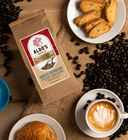
We bake biscotti in the same building as the roastery. Same morning, same hands that pull shots in the café out front. The malted chocolate depth of an Earthy & Seductive in the press, with one of our almond biscotti — dunk it. The biscotti softens into the coffee, the coffee picks up the almond, the whole thing turns into something more than either piece on its own. That's the entire reason Italians invented the pairing.
A few other combinations that work in our experience:
- Sumatra + Chocolate Almond Biscotti — full-bodied, deep, almost dessert-like. A serious morning move.
- Orient Espresso + Hazelnut Biscotti — the brown sugar and jasmine notes lift the roasted hazelnut. Easy, classic.
- Water Process Decaf + Black & White Biscotti — quieter, cozier. The decaf nighttime cup if you want a small sweet thing without the caffeine.
You can grab the Biscotti Sampler and a bag of coffee at the same time and try a few combinations. Not a sales pitch — just how I'd actually do it.
Quick Troubleshooting
If your press is coming out wrong, it's almost always one of these.
| Symptom | Likely Cause | Fix |
|---|---|---|
| Bitter, ashy | Over-extracted — water too hot, grind too fine, or coffee left in the press after pressing | Drop water to 190°F, coarsen grind, decant immediately |
| Sour, thin, hollow | Under-extracted — grind too coarse, water too cool, or beans past their window | Tighten grind one notch, check 195–200°F, check the roast date |
| Muddy, gritty cup | Grind too fine, fines slipping through mesh | Coarsen the grind, stir gently not vigorously |
| Plunger fights you hard | Grind way too fine | Coarsen significantly — should press in ~20 seconds with steady pressure |
| Plunger drops with no resistance | Grind too coarse | Tighten the grind a notch |
| Flat, papery, lifeless | Stale beans | Check roast date — if it's more than 4–5 weeks out, that's almost certainly the problem |
If you want a deeper diagnosis, run it through our Coffee Doctor — it walks you through the symptoms and gives you a fix.
French Press Coffee FAQ
What roast is best for French press coffee?
Dark and medium-dark roasts are the sweet spot. French press steeps for four full minutes, and that long contact pulls chocolate, caramel, and nutty depth out of a darker roast without turning it sour — while the heavier body fills the cup the way the method is built for. Medium roasts work well too; light roasts tend to come through thin and grassy in that window.
Can I use light roast in a French press?
You can, but it asks more of you. Light roasts were built for shorter, hotter brews, so in a four-minute steep they often read thin and a little grassy. If you want to try one, grind a touch finer, keep your water hotter (around 200°F), and expect a brighter, more delicate cup than a dark roast gives.
What grind size should I use for French press?
Coarse — about the texture of coarse sea salt or rough breadcrumbs. Too fine and the cup turns bitter and muddy as fines slip through the mesh; too coarse and it comes out weak and thin. If you're ordering pre-ground from us, choose the French Press / Percolator (coarse) option.
How much coffee do I put in a French press?
We brew at a 1:18 ratio — one gram of coffee for every eighteen grams of water. For our 34oz press that works out to about 34g of coffee to 600g of water. If you like a stronger cup, move toward 1:15; weigh it once and you'll know your number for good.
Why does my French press coffee taste bitter?
Usually one of three things: the grind is too fine, the water is too hot, or the coffee sat in the press after plunging and kept extracting. Coarsen your grind, drop your water to around 190°F for a dark roast, and pour the whole press out the moment you press it. Bitterness almost always traces back to over-extraction, not the beans themselves.
Should I use whole bean or pre-ground coffee for French press?
Whole bean, ground just before you brew. Once coffee is ground, oxygen reaches every surface at once and it goes flat within days — and French press hides nothing, so you taste that. If you don't own a grinder yet, a burr grinder is a better first investment than a fancier bag of beans, and our pre-ground French Press / Percolator grind is the next best thing.
What's the difference between a French roast and coffee for French press?
They sound alike but they're unrelated. French press is a brewing method; French roast is a roast level — beans pulled dark, at the start of second crack. A French roast happens to brew beautifully in a French press, but "coffee for French press" just means fresh, coarse-ground, medium-dark-to-dark coffee — it doesn't have to be a French roast specifically.
Why are my coffee beans oily — is that bad for French press?
A sheen on a dark roast is completely normal. Those are the bean's natural oils migrating to the surface during second crack, not a sign of staleness or low quality. In a French press it's actually an advantage: there's no paper filter to strip those oils, so they stay in the cup and give you that heavier, velvety body.
Should I bloom coffee in a French press?
You don't need a separate bloom the way you would in a pour over. In our method, pouring all the water at once and giving the crust a gentle stir at 30 seconds does the same job — it releases the trapped CO₂ and evens out the extraction. If you're brewing very fresh coffee and want to, you can pour just enough water to wet the grounds, wait 30 seconds, then top up — but for most cups, the 30-second stir is all you need.
How should I store coffee beans after opening?
Keep them in an airtight container at room temperature, away from light, heat, and moisture — a cupboard is perfect. Skip the fridge and freezer for coffee you're drinking day to day; the temperature swings pull moisture into the beans. The simplest fix of all is to buy in amounts you'll finish within two to three weeks of the roast date, and storage mostly takes care of itself.
The Simple Version
Buy a fresh dark or medium-dark roast with a roast date on the bag. Grind it coarse, the morning of. Use a 1:18 ratio with 190°F water. Stir at 30 seconds, press at 4:00, decant immediately. Pair it with a biscotti.
That's it. That's the whole game.
If you only buy one bag for French press, make it Earthy & Seductive. If you'd rather try a few in the same press, the Coffee Discovery Box gets you eight.
Brew it the way I laid out above. If a cup comes out off, run it through our Coffee Doctor and it'll tell you what to adjust — or come by the café in Greenport and we'll pull you a press at the bar.
— Joshua Sommer, Owner | Aldo's Coffee Company | Greenport, NY
Related Reading
- Coffee Grind Size Guide: Match Your Grind to Your Brew Method
- What Is a French Dark Roast? (Not What Most People Think)
- Why Are My Coffee Beans Oily? A Roaster Explains
- The Best Coffee for Cold Brew (And Why It's Easier Than You Think)
- The Best Dark Roast Coffee Beans (And How to Tell Bold From Burnt)